
A renowned author is set to publish a novel imagining America's future, featuring a striking prediction about how President Donald Trump will die.
Journalist and author Kurt Andersen has recently disclosed details of his forthcoming satirical work, "The Breakup," which depicts an America ripped apart by violence in the wake of widespread disorder sparked by President Trump's death.
"For a while I was thinking, oh, I should maybe, maybe I should write a nonfiction book about what the future could hold," Anderson told The Daily Beast Podcast. In the end, he chose to create a fictional narrative examining one potential vision of America's future.
The novel is set in 2035, with President Trump marking his 89th birthday at Trump Tower. In a crucial scene, as he descends his famous golden escalator - echoing his historic 2015 presidential campaign launch - the Republican leader suffers a "massive brain stroke."
Pandemonium breaks out almost instantly, as attendees assembled at Trump Tower to commemorate both the birthday and the 20th anniversary of his initial campaign announcement start spreading conspiracy theories that his death was the product of a "deep-state assassination."

The crowd pours into the streets in furious protest, with anger boiling over amongst many attendees who suspect foul play surrounding the leader's death. "It's the first spectacular piece of violence, spontaneous violence that then results a year later in an uprising, in a, in a true right-wing uprising, terrorist uprising," Andersen said.
The author revealed he began writing the novel prior to Trump securing re-election in 2024, with the manuscript "basically done" by the time he was sworn into office in 2025. Despite this, he opted to "darken" the storyline as the president's second term unfolded.
"[It] certainly required me to go through and darken the backstory... more horrible and nightmarish than I had had them in the earlier draft," Andersen said.
According to podcast host Joanna Coles, the book represents the "breakup of America."
The story follows a 23-year romantic relationship falling apart, mirroring the breakdown of the country as they once knew it when their love story first began.
"This time, the horror show of this term, the nightmare beyond what I expected," Andersen explained. "In the last year and a half, in the last three years since I was began writing this book, it has become much less far-fetched than it seemed when I began."
Andersen's novel and its anticipated fatal conclusion emerge at a time when the president's physical condition has remained a persistent topic of conversation throughout his second term. New details concerning the president's wellbeing surfaced from the book "Regime Change" by New York Times reporters Maggie Haberman and Jonathan Swan, which provided previously unrevealed details about the second Trump presidency.
According to Haberman and Swan, throughout his first year back in office, the president was "almost entirely housebound."

Not only would he predominantly move between his "comfort zones," the White House or one of his clubs, but he also purportedly informed his staff that following the 2024 election, he was "done with rallies, done with campaigning."
The book discloses that while the president had grown increasingly security-conscious after his two assassination attempts, there was another, potentially more personal explanation behind his new inclination for remaining indoors.
"He had spent four years of the Biden presidency mocking his successor's age and clearly diminished stamina," Haberman and Swan wrote. "But the fact that Trump had followed Biden by becoming the oldest man ever sworn into the office of the President did not mean he felt compelled to provide frequent health updates of his own. That he had aged since he last lived in the White House was obvious."

Aides grew concerned about the president for a number of reasons.
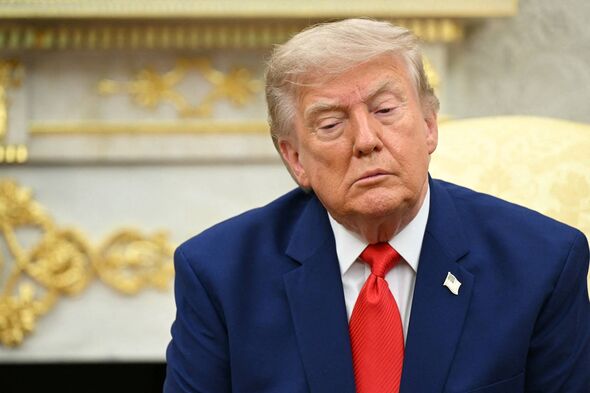
Beyond the repeated bruising - which the White House first put down to extensive handshaking before subsequently blaming his aspirin treatment - staff additionally observed his habit of nodding off during mid-afternoon meetings, alongside indications of what seemed to be slight hearing impairment.
Haberman and Swan note that the president regularly asked reporters to repeat their questions, positioning his hand behind his ear to better hear what was being said.
Significantly, meetings with foreign leaders started occurring in the Oval Office rather than the East Room, "in part because the acoustics were better, and he didn't have to stand for an hour."